Merge mining and AuxPoW: how it works

Introduction
Merge mining is a technique that lets a chain other than Bitcoin reuse Bitcoin's proof-of-work as its own. It lets Bitcoin miners use the same hashing effort to mine one or more auxiliary chains (Namecoin being the original and most well-known example), with no reduction in Bitcoin hashrate and only the additional requirement that miners or pools run auxiliary-chain software (e.g., a Namecoin node). The arrangement is one-sided: an auxiliary chain's nodes carry the code to recognise and validate the shared work, while Bitcoin itself is unchanged and unaware any of it is happening.
Beginning with a brief history of where the idea came from, this post walks through how Bitcoin and auxiliary-chain blocks are linked.
It covers the merkle structure that lets multiple auxiliary chains piggyback on individual Bitcoin blocks, the Auxiliary Proof-of-Work (AuxPoW) record carried by each auxiliary block, and the cryptographic checks an auxiliary node performs to validate a merge-mined auxiliary block.
A companion post catalogues the chains that have adopted AuxPoW with Bitcoin as their parent and examines which mining pools embed merge-mining commitments in their coinbases.
Not every Bitcoin-merge-mined chain uses AuxPoW, however; some embed the commitment in a coinbase output instead (OP_RETURN tag-based merge mining, covered later).
The bulk of this post focuses on AuxPoW.
This piece is a bit of a detour from my planned treatment of Bitcoin network monitoring topics, such as the peer observer ecosystem and the network's important properties, but there is good reason for it. Each AuxPoW chain that has merge-mined with Bitcoin holds, in its own permanent record, a copy of the Bitcoin block header whose proof-of-work was reused for each of its merge-mined blocks, including headers that Bitcoin's own canonical chain discarded. More specifically, those AuxPoW chains are a side-channel into block propagation (one of those important network properties) and the stale blocks those propagation delays help create. A follow-up post uses that side-channel to put numbers on a long-standing theoretical claim: that smaller mining pools produce more stale blocks, relative to their hashrate, than larger ones. This post is the groundwork.
A brief history
Merge mining is a Satoshi-era idea, first sketched on BitcoinTalk in late 2010 and realised a year later as part of Namecoin. In mid-November 2010, a BitcoinTalk thread titled "BitDNS and Generalizing Bitcoin" opened a discussion about whether Bitcoin's chain should host a DNS-like service for human-readable identifiers. The first half of that title was the specific proposal; the second half, the broader question the thread quickly turned to: what else could a proof-of-work chain be used for, and where should those services live, on Bitcoin's chain or separately?
Satoshi weighed in on 9 December 2010, arguing that BitDNS should be a completely separate network with its own block chain, but that the two could share their proof-of-work:
I think it would be possible for BitDNS to be a completely separate network and separate block chain, yet share CPU power with Bitcoin. The only overlap is to make it so miners can search for proof-of-work for both networks simultaneously.
The networks wouldn't need any coordination. Miners would subscribe to both networks in parallel. They would scan SHA such that if they get a hit, they potentially solve both at once. A solution may be for just one of the networks if one network has a lower difficulty.
[...]
Instead of fragmentation, networks share and augment each other's total CPU power. This would solve the problem that if there are multiple networks, they are a danger to each other if the available CPU power gangs up on one. Instead, all networks in the world would share combined CPU power, increasing the total strength. It would make it easier for small networks to get started by tapping into a ready base of miners.
This idea was the nexus for what became merge mining.
Namecoin launched in April 2011 as the first chain to come out of the BitDNS thread. Its early months were a case study in the problem Satoshi's reply had warned about: the chain ran with its own independent SHA-256d hashrate, small enough to be vulnerable on its own. About six months later, in October 2011, the merge-mining hard fork activated at Namecoin block 19,200. In practice every Namecoin block from that height onwards has carried an AuxPoW record committing it to a Bitcoin parent block. The specification that emerged from that work, written primarily by Namecoin's early contributors, became the baseline for Bitcoin-parent AuxPoW chains.
Two chains, one hash
Under that specification, two chains advance in parallel from the same Bitcoin hashing effort, each with its own independent difficulty target.
Bitcoin's parent_target is the threshold a candidate Bitcoin block header's hash must clear for the block to qualify as a valid Bitcoin block.
The auxiliary chain's aux_target is set independently of parent_target and almost always numerically much larger (i.e., easier to satisfy), so the chain produces blocks at its own intended rate.
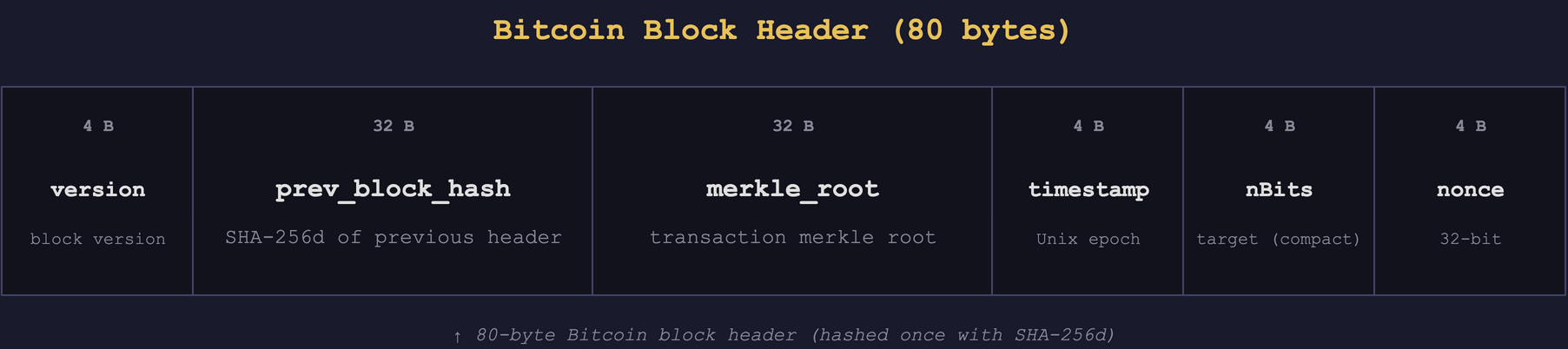
version, 32 bytes prev_block_hash, 32 bytes merkle_root, 4 bytes timestamp, 4 bytes nBits (the compact-encoded parent_target), and 4 bytes nonce. Both Bitcoin and the auxiliary chain check the SHA-256d of these 80 bytes against their respective targets.Each candidate Bitcoin block has its 80-byte header (Figure 1) put through a single SHA-256d evaluation, and the resulting 32-byte digest is compared independently against both targets (Figure 2). For a merge-mining miner, three outcomes are possible.
- If the hash exceeds
aux_target(and therefore the lowerparent_targettoo), the candidate is discarded and neither chain extends. - If the hash falls to or below
aux_targetbut still aboveparent_target, the candidate is a valid auxiliary block, but Bitcoin rejects it. - If the hash is at or below
parent_target, both bars are cleared at once: the candidate is a valid Bitcoin block (assuming the rest of consensus passes) and a valid auxiliary block.
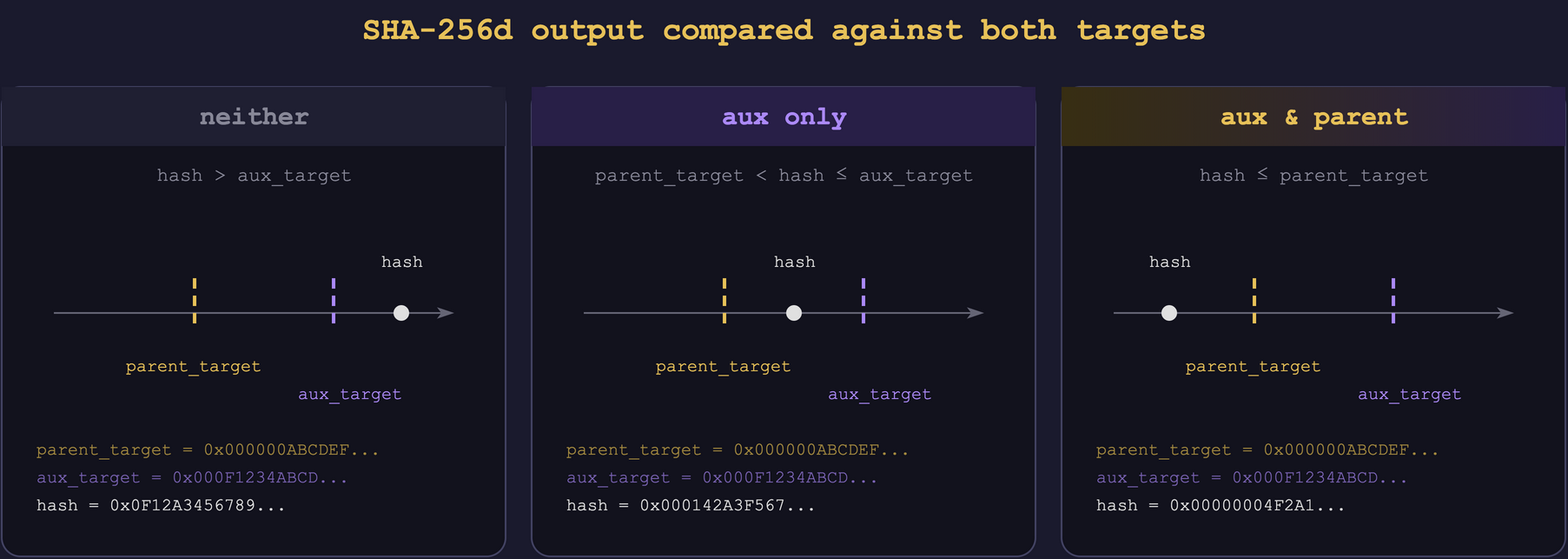
aux_target, valid for neither chain. Middle panel: hash falls between parent_target and aux_target, valid for the auxiliary chain only. Right panel: hash is at or below parent_target, valid for both Bitcoin and the auxiliary chain. Example hex values illustrate the inequality chain through their leading-zero counts.The third outcome splits further on Bitcoin's side: those candidates either become canonical Bitcoin blocks or stales that lost a chain race. Because every accepted auxiliary block stores its parent header in an AuxPoW record (detailed in the next section), there are three categories of parent headers stored in the auxiliary chain (Figure 3):
- Canonical Bitcoin blocks (won their chain race; e.g., Block
B) - Bitcoin stales (met
parent_targetbut lost their chain race; e.g., the stale that lost to BlockB+1) - Aux-only parent headers (hash met only
aux_target; e.g., the parent header for NMC blockN+2)
. Candidate parent headers either fail both targets, clear only `aux_target`, or clear `parent_target`. Of those that clear `parent_target`, one becomes a canonical Bitcoin block (Block `B`) while another loses the chain race to Block `B+1` and becomes a stale. All three retained outcomes (canonical, stale, aux-only) appear in AuxPoW records on the auxiliary chain.](/assets/blog/2026/merge-mining/merge-mining-flow.png)
aux_target, or clear parent_target. Of those that clear parent_target, one becomes a canonical Bitcoin block (Block B) while another loses the chain race to Block B+1 and becomes a stale. All three retained outcomes (canonical, stale, aux-only) appear in AuxPoW records on the auxiliary chain.The stales are what make AuxPoW chains a side-channel into Bitcoin's PoW history. This is the premise of Stifter et al.'s 2018 paper Echoes of the Past: Recovering Blockchain Metrics From Merged Mining, which used the AuxPoW records on merge-mined chains to reconstruct Bitcoin's historical stale block and fork rates, surfacing a non-negligible portion of stale blocks absent from the live monitoring record (this work will be revisited in detail in a future post).
The coinbase commitment
On the Bitcoin (parent) side, the AuxPoW marker is a 44-byte blob inside the coinbase's scriptSig (coinbases without merge-mining simply don't carry it).
Thus Bitcoin commits to AuxPoW data (if present) indirectly through the block header's merkle_root; see the Reminder: from block header to coinbase scriptSig section below for the full details.
Reminder: from block header to coinbase scriptSig
The block header is the 80-byte object whose hash is tested against parent_target and, when merge-mining, against aux_target too.
One of its six fields is merkle_root: the root of the merkle tree built from every transaction txid in the block body.
The coinbase transaction's txid is leaf 0 in that tree, and the coinbase transaction's first input contains the scriptSig field (Figure 4).
This is a "free-form" metadata area that miners use to record:
- The block height, as required by BIP 34,
- An extranonce that the mining hardware iterates on,
- The AuxPoW marker (optional; only when merge-mining), and
- The pool-identifying tags and any additional miner data (optional).
For more on the extranonce mechanism, see learnmeabitcoin.com's excellent interactive nonce explainer.
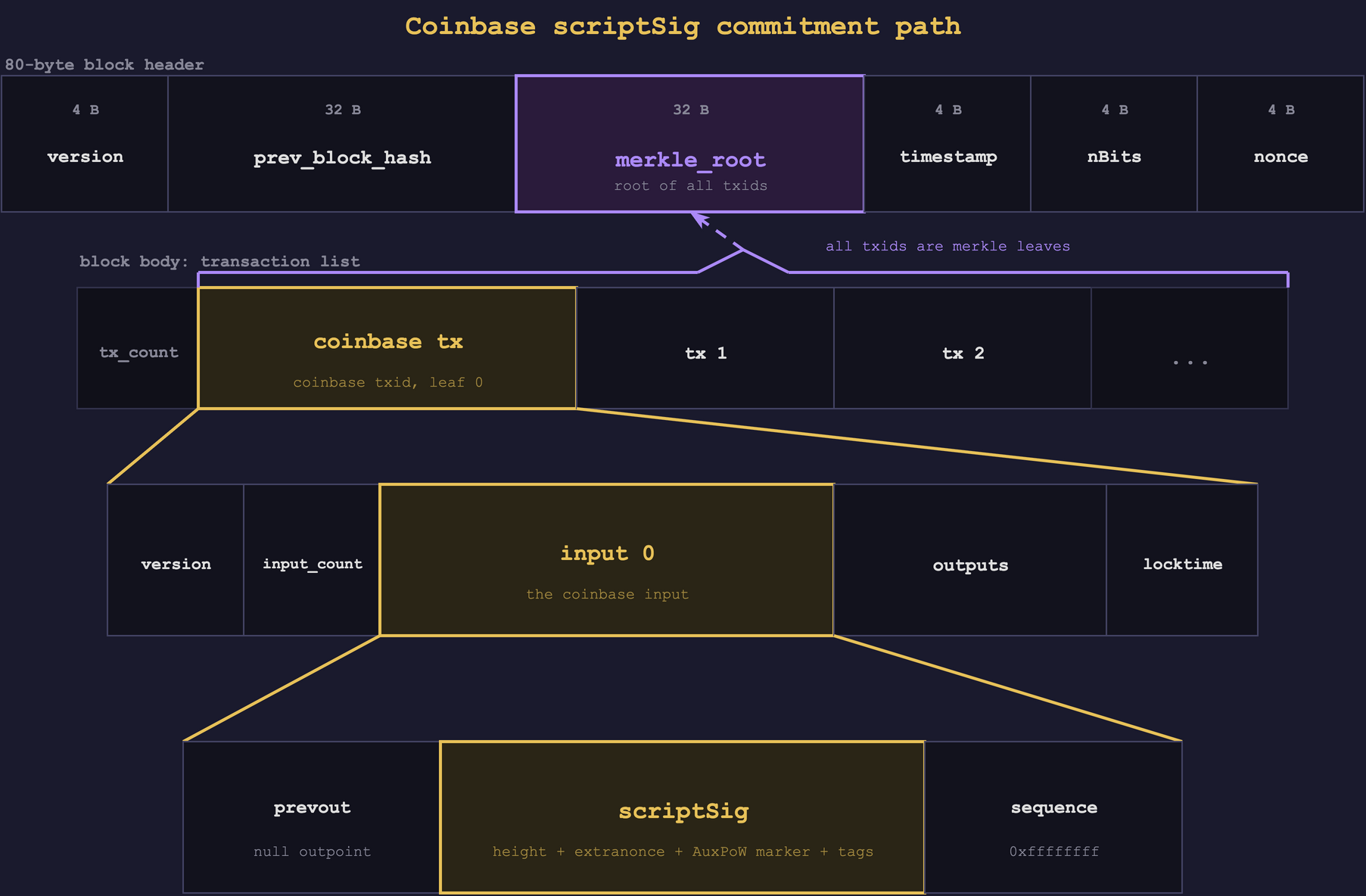
scriptSig into the Bitcoin block header. The scriptSig sits inside input 0 of the serialised coinbase transaction, the coinbase transaction is the first transaction in the block body, the coinbase txid and all following transaction txids are merkle leaves, and the resulting merkle root is stored in the 80-byte block header.The AuxPoW marker within the coinbase scriptSig has four fields as illustrated in Figure 5.
The first 4 bytes are the 0xFA BE 6D 6D magic, a fixed identifier that lets auxiliary-chain nodes easily locate the marker without ambiguity.
The next 32 bytes are the aux_merkle_root, the commitment that links this Bitcoin block to one or more auxiliary blocks.
The final 8 bytes are two little-endian uint32 values: merkle_size and merkle_nonce.
Auxiliary-chain nodes use those two values to locate each chain's commitment within the merkle tree.
What that tree looks like on the auxiliary-chain side is the subject of the next section.
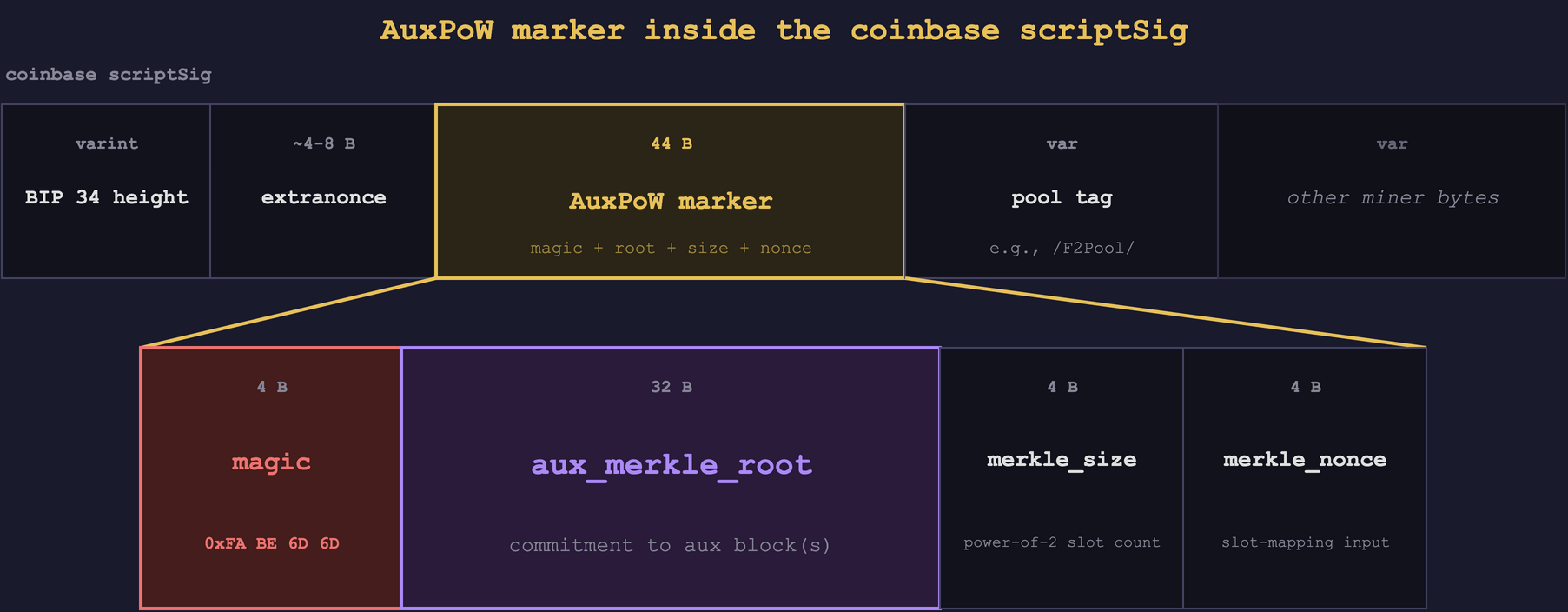
scriptSig. Four fields: a 4-byte magic constant 0xFA BE 6D 6D, a 32-byte aux merkle root committing to one or more auxiliary block hashes, a 4-byte merkle_size declaring how many slots the merkle tree contains, and a 4-byte merkle_nonce used in the slot-mapping calculation. The marker sits alongside other coinbase scriptSig data such as the BIP 34 block height, the extranonce, and any pool-identifying tags.From Bitcoin's side, none of these 44 bytes are consensus-relevant. Bitcoin's nodes never read the marker and have no way of knowing the block is also a valid merge-mined block somewhere else. That is the whole reason merge mining is one-sided: an auxiliary chain can leverage Bitcoin without Bitcoin ever knowing about it.
The merkle slot tree
The merkle slot tree is the structure that lets multiple auxiliary chains piggyback on the same parent Bitcoin block at once.
Each participating chain occupies one position in a fixed-size merkle tree, and the single root of that tree is committed in the parent coinbase's AuxPoW marker as the 32-byte aux_merkle_root introduced in the previous section.
A "slot" is one such leaf position, indexed from 0 to merkle_size - 1, where merkle_size is a power of two also declared in the marker (Figure 6).
Each slot holds a 32-byte value: for an occupied slot, that value is the auxiliary block hash; for an unused slot, it is just arbitrary 32-byte filler, not another meaningful commitment.
The miner locks in the filler choice before computing the root, and the same filled-in tree backs every chain's commitment into this parent block.
The Namecoin worked example later in this post shows an actual filler value picked by AntPool.
The tree then hashes upwards, Bitcoin-style, using double SHA-256.
In the four-slot example of Figure 6, h01 = SHA-256d(s0 || s1), h23 = SHA-256d(s2 || s3), and aux_merkle_root = SHA-256d(h01 || h23).
At each level, two 32-byte children are concatenated into a 64-byte input, and the hash output is again 32 bytes.
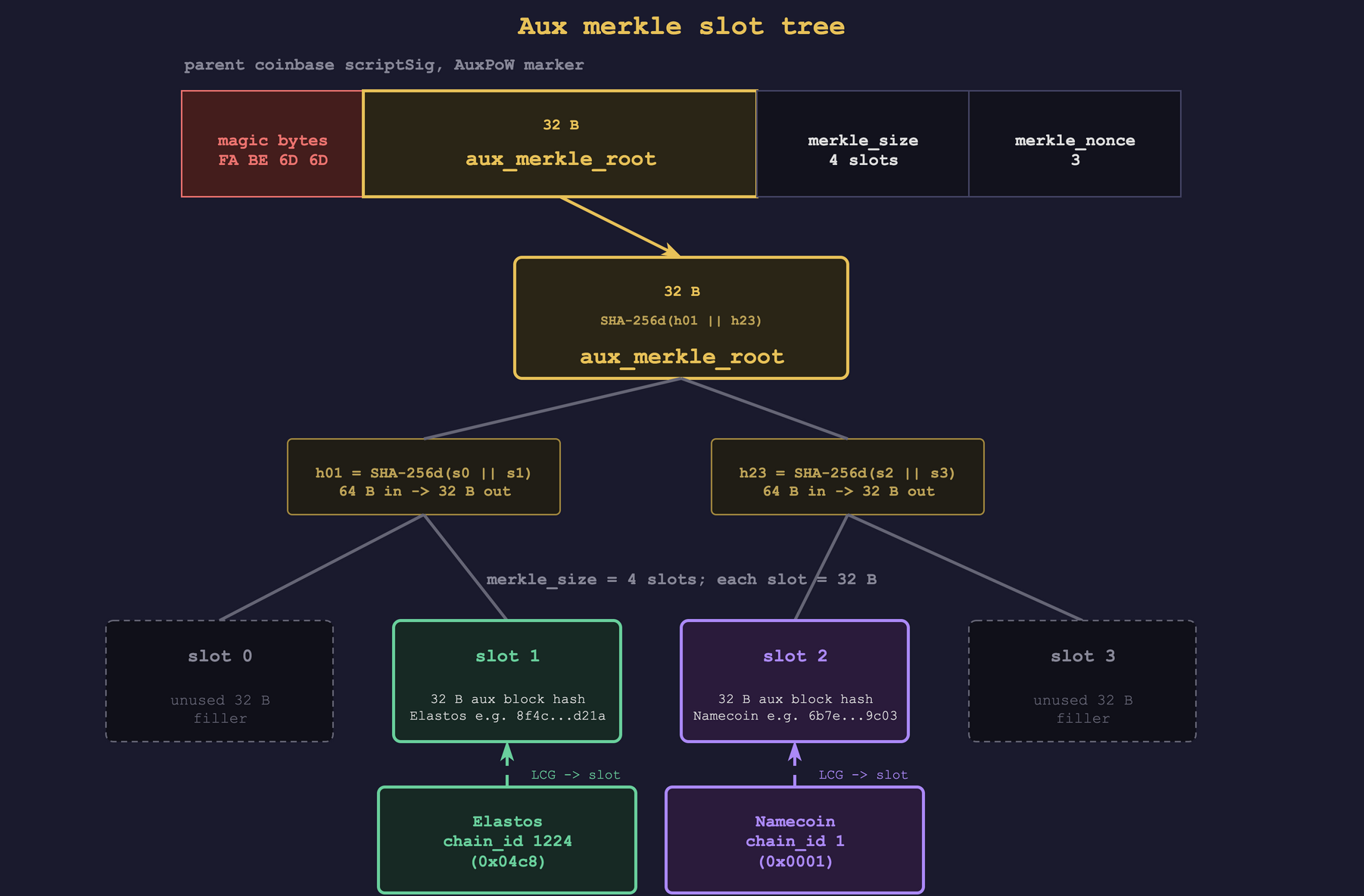
aux_merkle_root, is committed in the parent coinbase's AuxPoW marker (reproduced at top). Each slot is 32 bytes. Slot 1 holds Elastos's block hash (chain_id 1224); slot 2 holds Namecoin's (chain_id 1); the other slots are unused 32-byte filler. Each internal node, and finally the root, is SHA-256d over two 32-byte child values.Which slot a chain occupies is determined by its chain_id combined with the merkle_nonce.
The chain_id is fixed by the chain; there is no central chain_id registry, and apparently no real coordination on assignment either.
The closest thing is BitcoinTalk thread 769073, opened in 2014, three years after Namecoin's AuxPoW fork, as a catalogue of chain_ids (though it listed Namecoin's chain_id incorrectly until July 2015).
In practice this doesn't seem to have been a problem: the population of active AuxPoW chains is small, and a chain_id clash only bites when a single parent block commits to both colliding chains at once.
merkle_nonce was meant to be the miner's tuning knob for avoiding slot collisions when committing to multiple auxiliary chains at once, but the published formula only shifts colliding chains together.
This failure is called out in the Bitcoin Wiki Aux work merkle tree notes and in the Nonce for merged mining chain merkle tree index BitcoinTalk thread.
The mapping process uses a deterministic linear congruential generator (LCG) to decide placement (see the Slot mapping details section below). It does not derive any auxiliary block hashes; the 32-byte values come from the auxiliary chains' block headers, and those hashes get committed into the slots.
Slot mapping details
The slot index is computed from merkle_nonce and chain_id, with all arithmetic on 32-bit unsigned integers (multiplications wrap modulo \(2^{32}\)).
Each rand = rand * 1103515245 + 12345 line is one LCG step, using the multiplier (1103515245) and increment (12345) from ANSI C's rand(), but with 32-bit unsigned wraparound rather than ANSI C's mod 2^31.
The chain_id is mixed in between two iterations, and the final modulo reduces the 32-bit output to a slot index:
rand = merkle_nonce
rand = rand * 1103515245 + 12345
rand = rand + chain_id
rand = rand * 1103515245 + 12345
slot = rand mod merkle_size
The result is a slot index between 0 and merkle_size - 1.
However, if two chains' chain_ids collide for a given power-of-two merkle_size, changing merkle_nonce does not fix the collision; it only moves both chains together.
The miner must use a larger merkle_size, omit one chain, or rely on chain IDs that do not collide modulo the chosen tree size.
And because each chain's verifier independently runs the LCG to find its expected slot, a miner cannot silently put two chains at the same leaf: a verifier whose slot is occupied by another chain's commitment rejects the AuxPoW.
The simplest case is merkle_size = 1, where a miner is committing to only one auxiliary chain.
The tree collapses to a single leaf: the chain's block hash sits at the root directly, and the merkle_nonce is irrelevant (the LCG always returns slot 0).
In practice, miners committing to multiple AuxPoW chains do so via a single shared slot tree: the same hashing effort can earn a block reward from every chain in the tree whose aux_target the resulting hash clears.
A pool mining Namecoin alongside Elastos and other AuxPoW chains picks a merkle_size to fit the chains it commits to, with each occupying the slot its chain_id resolves to.
Each participating chain ends up with a different proof through this one shared tree: its own slot, its own sibling hashes, its own leaf-to-root path (side mask, introduced in the next section) through the tree.
The parent block, the coinbase marker, and the aux_merkle_root are common to all of them; the per-chain proof is what differs.
The worked example later in this post walks through such a tree in detail.
The AuxPoW record
The standard AuxPoW format, originally specified by Namecoin and adopted byte-for-byte by most Bitcoin-parent AuxPoW chains, puts an AuxPoW record between the 80-byte auxiliary header and the block body's transaction list. This AuxPoW record is a variable-sized structure with five fields, as shown in Figure 7.
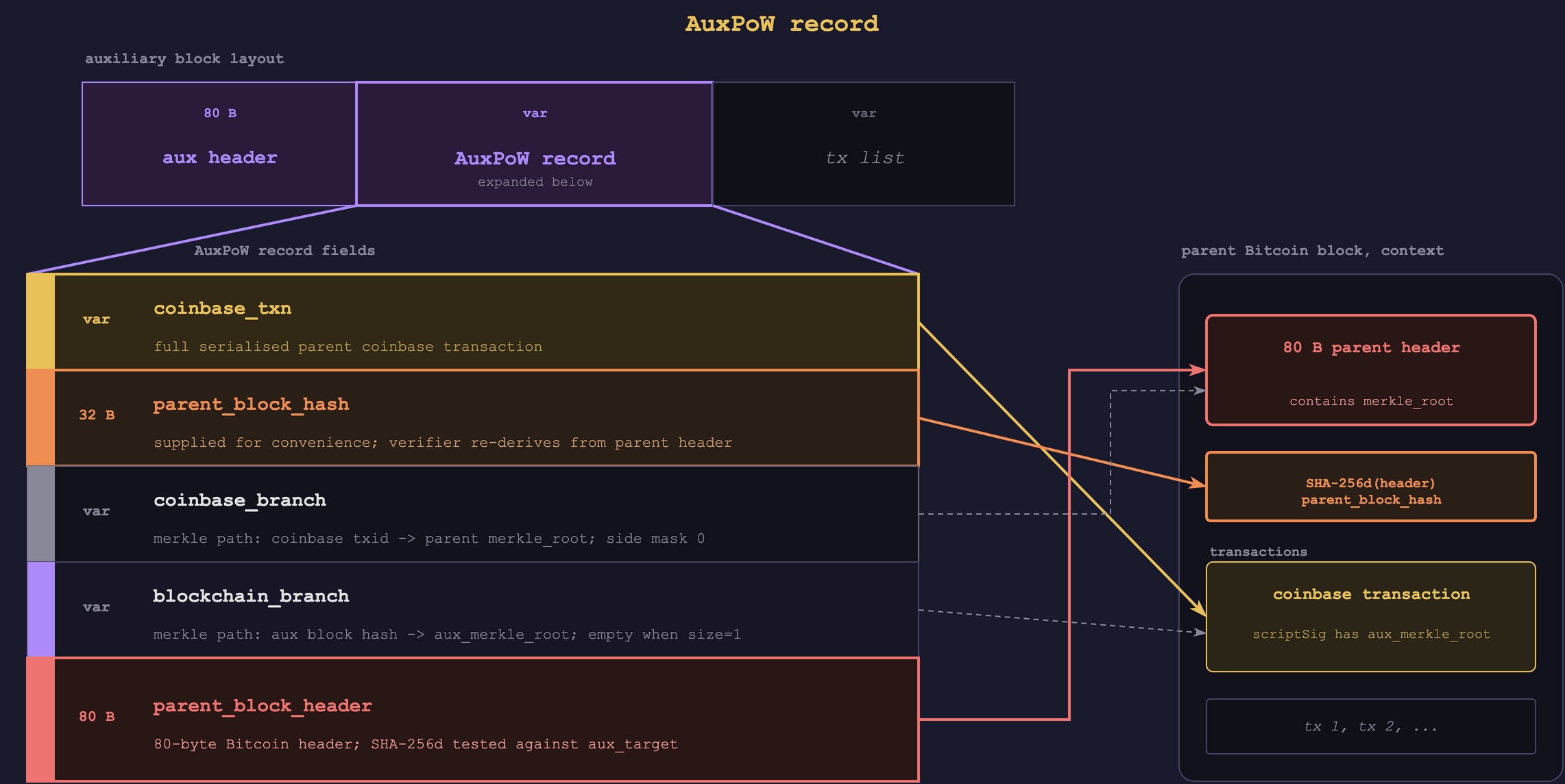
coinbase_txn and parent_block_header are copied parent-side data; parent_block_hash is a redundant derived hash. The other two fields (coinbase_branch, blockchain_branch) are merkle paths that let the auxiliary chain's verifier reconstruct the link to the parent's proof-of-work.Three fields are parent-side data carried into the auxiliary block.
coinbase_txn is the full serialised parent coinbase transaction; the verifier scans its scriptSig for the 0xFA BE 6D 6D magic and reads the aux_merkle_root out of the bytes that follow.
parent_block_hash is a 32-byte convenience value that the verifier ignores.
Early Namecoin AuxPoW blocks even shipped it in inconsistent byte order (some in standard little-endian internal byte order, some reversed) without breaking validation.
parent_block_header, by contrast, is the field that actually drives validation: the verifier computes SHA-256d over its full 80 bytes and tests the result against aux_target to confirm the auxiliary block's proof-of-work.
The remaining two fields are compact merkle proofs, not copies of the full parent transaction tree or the full auxiliary slot tree.
They give the verifier just enough sibling hashes to fold a known starting hash up to the parent's transaction merkle_root (for coinbase_branch) and the aux_merkle_root (for blockchain_branch).
For coinbase_branch, the start hash is txid(coinbase_txn) and the expected root is the Bitcoin transaction merkle_root from parent_block_header.
This proves that the proof-of-work in parent_block_header was performed over a transaction merkle root consistent with a tree containing coinbase_txn.
That coinbase carries the AuxPoW marker that commits to this auxiliary chain (and to any others sharing the same slot tree).
For blockchain_branch, the start hash is this auxiliary block's hash and the expected root is the aux_merkle_root found in the parent coinbase's AuxPoW marker.
This proves that the coinbase marker commits to this auxiliary block's hash (alongside any other chains' block hashes in the shared slot tree).
The two branch payloads carry the "middle part" of those two checks: the sibling hashes and the side masks needed to fold the start hash up to the expected root (see the Merkle branch details section below). How these fields combine into a verification check is the subject of the next section.
Merkle branch details
Both branches use the same three-input fold pattern:
- A start hash, fetched from surrounding AuxPoW data (it is never stored inside the branch payload).
- A branch payload: a CompactSize sibling count, the sibling hashes themselves, and a 4-byte side mask whose role differs per branch.
- An expected root, also fetched from surrounding AuxPoW data.
The fold sets current to the start hash, then walks branch_hash[] one sibling at a time, reading the matching bit from the side mask starting at bit 0.
If the bit is 0, current sat on the left at that tree level and the step is current = SHA-256d(current || sibling); if the bit is 1, current sat on the right and the step is current = SHA-256d(sibling || current).
Read from bit 0 upward, the side mask is therefore the leaf-to-root path of the value being proved.
After the last sibling, current must equal the expected root.
The two branches differ in what each input refers to and in what the side mask encodes.
coinbase_branch
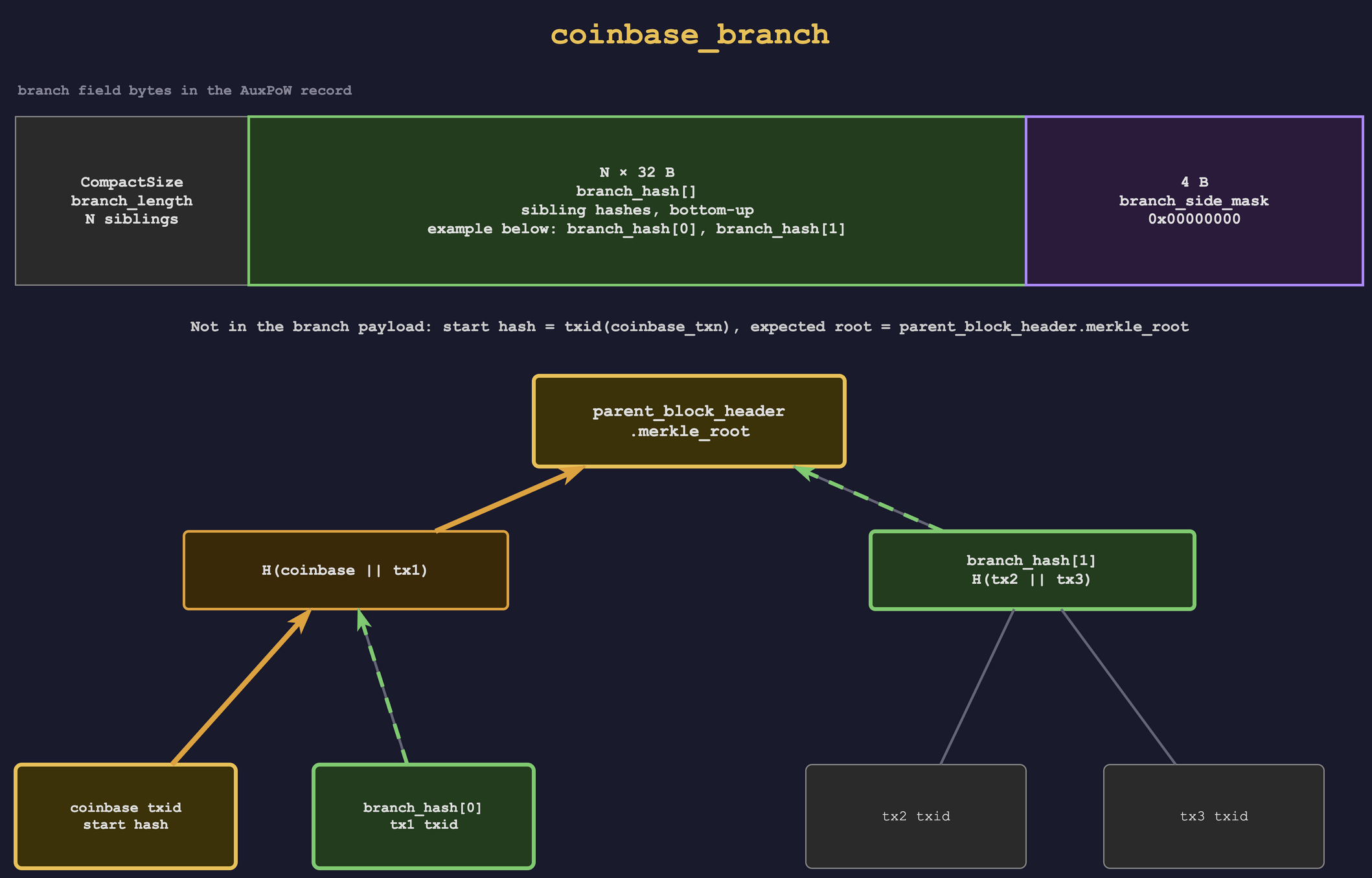
coinbase_branch shown as a merkle proof through the parent Bitcoin transaction tree. The branch field carries the CompactSize length, the sibling hashes, and the 4-byte side mask; the coinbase txid and the expected parent header merkle_root come from surrounding AuxPoW data.- Start hash:
txid(coinbase_txn), the SHA-256d of the serialised parent coinbase transaction carried in this same AuxPoW record. - Expected root: the Bitcoin transaction
merkle_rootfromparent_block_header. - Side mask: all four bytes are zero, because the coinbase is always at leaf 0 of the parent transaction tree, putting
currenton the left at every level.
A successful fold ends with current equal to the parent header's merkle_root.
blockchain_branch
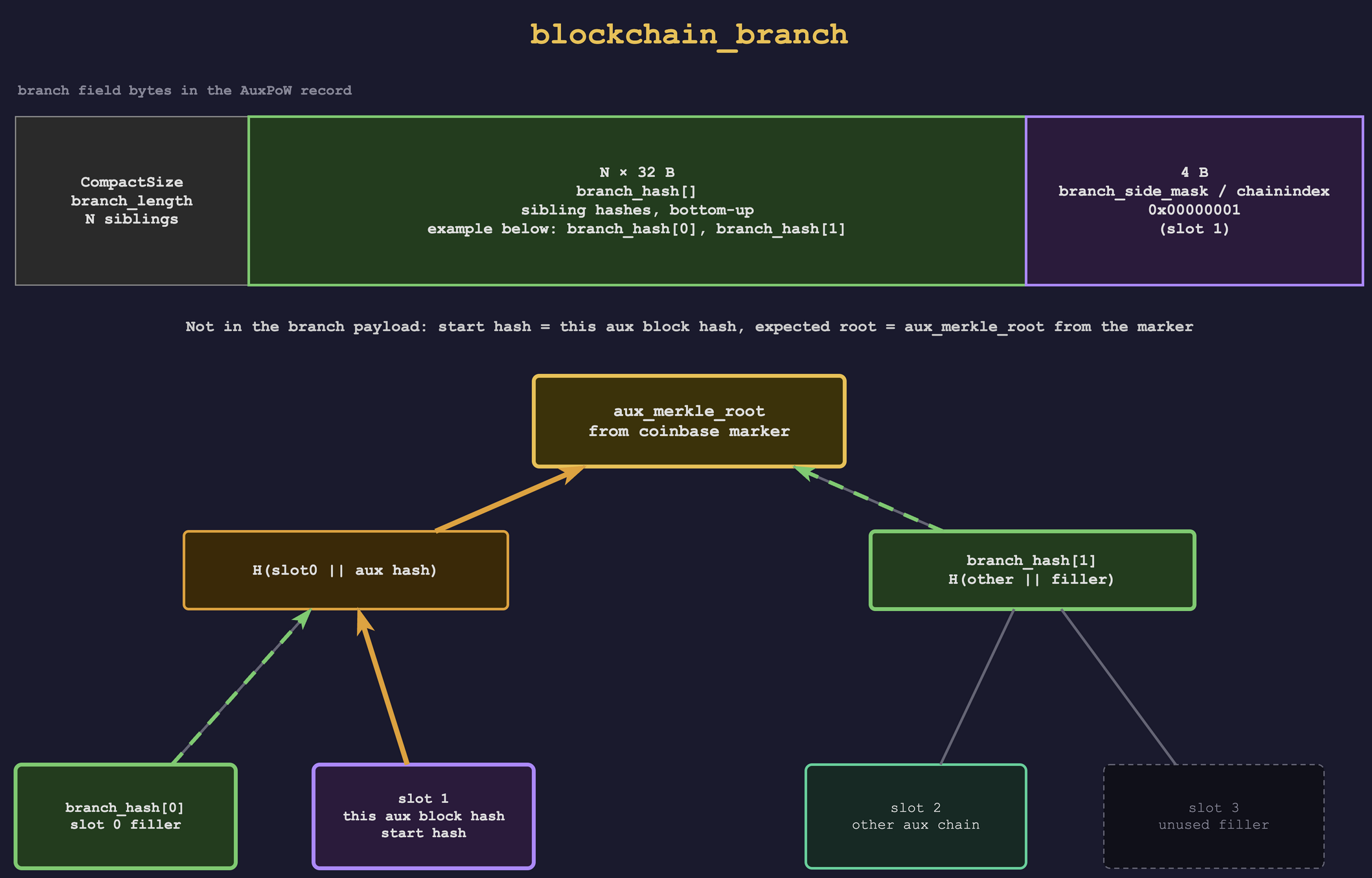
blockchain_branch shown as a merkle proof through the auxiliary merkle slot tree. The branch field carries the CompactSize length, the sibling hashes, and the 4-byte side mask (this chain's slot index); the auxiliary block hash and expected aux_merkle_root come from surrounding AuxPoW data.- Start hash: this auxiliary block's header hash.
- Expected root: the
aux_merkle_rootembedded in the parent coinbase's AuxPoW marker. - Side mask: the four bytes hold this chain's slot index in the slot tree, little-endian, so its binary digits are already the per-level left/right pattern the fold needs (bit 0 at the leaf level).
The mask is chain-specific: every other auxiliary chain merge-mined into the same parent Bitcoin block carries its own
blockchain_branch(own start hash, own sibling hashes, own slot index), and they all fold up to the same sharedaux_merkle_root.
The verifier also independently derives the expected slot index from chain_id, merkle_nonce, and merkle_size, and rejects the proof if it differs from the side-mask value.
When the slot tree has only one leaf (merkle_size = 1), the payload reduces to 5 bytes of zeros: 0x00 00 00 00 00.
The fold has no siblings to process, so the start hash is already the expected root.
A successful fold ends with current equal to the aux_merkle_root from the parent coinbase marker.
Verification
For an auxiliary chain's node, verification answers a single question: does this candidate AuxPoW block actually inherit the parent's proof-of-work? The PoW link verification can be summarised as five checks, and the PoW link is valid only if all of them pass (Figure 10).
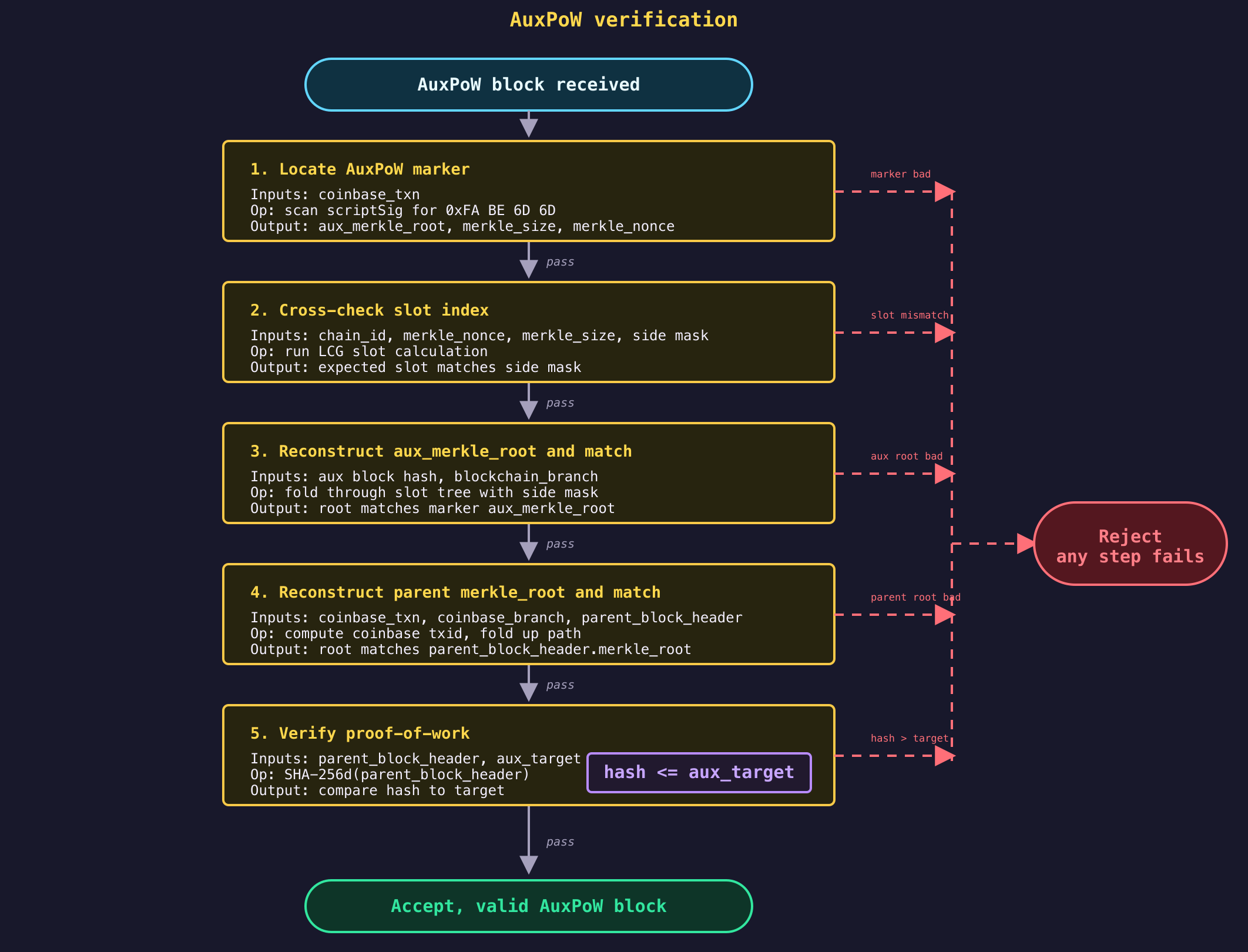
coinbase_txn's scriptSig and extract aux_merkle_root, merkle_size, and merkle_nonce, (2) cross-check that the LCG-derived slot for this chain matches blockchain_branch's side mask, (3) fold this aux block's hash up through blockchain_branch and confirm the reconstructed root matches the marker's aux_merkle_root, (4) fold the coinbase txid up through coinbase_branch and confirm the reconstructed root matches parent_block_header.merkle_root, (5) verify SHA-256d(parent_block_header) ≤ aux_target. All five must pass.The order below establishes identity first (steps 1 and 2) before walking the chain of commitments from the auxiliary block out to the parent's proof-of-work (steps 3 through 5).
Real implementations (e.g., Elastos's AuxPow.Check, following the Bitcoin Wiki specification) sequence the same checks differently and also perform additional structural validation of the AuxPoW record.
- Locate the AuxPoW marker inside the parent coinbase: scan
coinbase_txn'sscriptSigfor the0xFA BE 6D 6Dmagic, and read the embeddedaux_merkle_root,merkle_size, andmerkle_noncefrom the bytes that follow. - Cross-check the slot index: independently derive the expected slot by running the LCG over
chain_idand the marker'smerkle_nonceandmerkle_size, and confirm it matches the slot encoded inblockchain_branch's side mask. - Reconstruct
aux_merkle_root: starting from this auxiliary block's hash (SHA-256d of its 80-byte header), fold the hash up throughblockchain_branch(using the side-mask bits validated in step 2 to positioncurrentleft or right at each level), and confirm the resulting root matches theaux_merkle_rootextracted from the marker in step 1. - Reconstruct the parent block's transaction
merkle_root: compute the coinbase txid (SHA-256d ofcoinbase_txn) and fold it up throughcoinbase_branch, and confirm the resulting root matches themerkle_rootfield insideparent_block_header. - Verify the proof-of-work: compute SHA-256d of
parent_block_headerand check that the resulting hash is at or belowaux_target.
Step 5's aux_target test, looser than Bitcoin's parent_target, is what admits aux-only parent headers (those clearing aux_target but not parent_target) into the auxiliary chain's record.
Combined with the canonical blocks and stales that clear both targets, the record collects all three populations of parent headers the post identified earlier.
Worked example: Namecoin block 823,506
We walk through verification on a recent Namecoin block: block 823,506, mined by AntPool. This is a typical modern AuxPoW block:
merkle_size = 16: multiple AuxPoW chains committed via the slot tree,- A 4-sibling
blockchain_branch: one sibling per merkle level, \(\log_2(16) = 4\), and - A 13-sibling
coinbase_branch.
The relevant fields from the block JSON (annotated; the full record is at the link above; chainindex is the JSON name for the side mask):
{
  "hash":       "3e78ac34...9c9f6d88",                     // aux block (Namecoin) hash
  "auxpow": {
    "chainindex": 11,                                      // Namecoin's slot in the parent's slot tree
    "chainmerklebranch": [                                 // blockchain_branch siblings (4)
      "000000000000000000000000000000000000000000000000000000000000000a",
      "8ccfc263c108561c4e1c6c30b49fdab67c4ac12090291de80b9f07725c72717c",
      "ace26173348b3779777fdfd38835f76b2e5e0cf0f1e32b3c01fd9c6822c7c9b1",
      "a697adc4c5f4b32251e5ecd1aa16d038256e3750b8639c51df780745cc2db842"
    ],
    "merklebranch": [ /* 13 hashes - coinbase_branch siblings, omitted */ ],
    "tx": {
      "txid":      "c6cd5ec9...14e37cd5",                  // parent coinbase txid
      "vin":       [{"coinbase": "03ab770e...00000000"}],  // dissected below
      "blockhash": "00000000...20906c38"                   // parent Bitcoin block hash
    },
    "parentblock": "00000420...61514998"                   // serialised 80-byte parent header
  }
}
The parent coinbase scriptSig, dissected into fields:
"03ab770e"                                                         // BIP 34 push: parent height 948,139
"19" "4d696e656420627920416e74506f6f6c20"                          // 25-byte push containing a 17-byte tag: "Mined by AntPool "
     "87003601907790c0"                                            //   ...and 8 bytes pool extranonce
"fabe6d6d"                                                         // AuxPoW magic
"5a9c0198abca4e8c94a1ce47b0f09cf843e33a6a4d3aaf6b9240b08061d68a42" // aux_merkle_root (matches step 3 fold)
"10000000"                                                         // merkle_size = 16 (LE u32)
"00000000"                                                         // merkle_nonce = 0
"0000e66cf007010000000000"                                         // trailing scriptSig bytes (pool extras)
Step 1 (locate marker in parent coinbase).
Inside the parent coinbase's scriptSig, the magic fa be 6d 6d sits at byte offset 30, after a BIP 34 height push and a 25-byte push containing the 17-byte ASCII tag Mined by AntPool plus 8 bytes of pool extranonce.
The 32 bytes following the magic are 5a9c0198...61d68a42, which we'll match against the fold result in step 3.
The trailing 10 00 00 00 and 00 00 00 00 give merkle_size = 16 and merkle_nonce = 0.
Step 2 (cross-check slot index).
Running the LCG over chain_id = 1 (Namecoin), merkle_nonce = 0, and merkle_size = 16 (the latter two from the marker bytes in step 1) returns 11, matching the side mask carried in blockchain_branch's chainindex field.
Step 3 (reconstruct aux_merkle_root).
Namecoin's slot in this block is 11 (validated in step 2), carried in the AuxPoW record's chainindex field (the JSON-friendly form of the 4-byte side mask at the tail of blockchain_branch).
That slot index doubles as the side mask for the four-sibling replay: slot 11 in binary is 1011, so reading bit 0 (the LSB) first, the side bits at levels 0, 1, 2, 3 are 1, 1, 0, 1.
We start current at the aux block header hash from the JSON's hash field, then apply four SHA-256d steps, each pairing current with the next sibling from chainmerklebranch[]:
current = 3e78ac34...9c9f6d88 (aux block header hash)level 0 (bit 1, current on the right):
current = SHA-256d(00000000...0000000a ‖ 3e78ac34...9c9f6d88)
= 1ef8737d...e74dc89f
level 1 (bit 1, current on the right):
current = SHA-256d(8ccfc263...5c72717c ‖ 1ef8737d...e74dc89f)
= 3c11d081...44b313cf
level 2 (bit 0, current on the left):
current = SHA-256d(3c11d081...44b313cf ‖ ace26173...22c7c9b1)
= fe16c528...4a10d456
level 3 (bit 1, current on the right):
current = SHA-256d(a697adc4...cc2db842 ‖ fe16c528...4a10d456)
= 5a9c0198...61d68a42
The final current, 5a9c0198...61d68a42, is the reconstructed aux_merkle_root, matching the aux_merkle_root extracted from the marker in step 1.
Step 4 (reconstruct parent merkle_root and match).
The start hash is the coinbase txid, c6cd5ec9...14e37cd5.
The side mask is 0x00000000, so at every level current is on the left and the sibling on the right (the coinbase is always leaf 0 regardless of how many transactions sit beside it).
The branch carries 13 siblings, consistent with a parent transaction merkle tree of 4,097 to 8,192 leaves.
Folding all 13 in yields d63208d5...3d0aa08d, matching the merkle_root field of parent_block_header.
Step 5 (verify PoW).
SHA-256d of parent_block_header reproduces the parent block hash.
Namecoin's aux_target at this height has compact form 0x1703e336, which expands to a 32-byte target with nine leading zero bytes followed by 0x03 e3 36 00 ....
Lining up the hash and target as big-endian byte strings:
hash:    00 00 00 00 00 00 00 00 00 02 ...
target:  00 00 00 00 00 00 00 00 00 03 e3 36 ...
The first nine bytes are equal; at the tenth byte, the hash (0x02) is below the target (0x03), so the hash is below aux_target and the parent's work clears it.
That same hash, however, exceeds Bitcoin's parent_target at this height (compact bits = 0x17021ff0), making this parent aux-only (the third category from Two chains, one hash).
Bitcoin's canonical block at height 948,139 is a different hash (000000000000000000018551...87613a79); only Namecoin's AuxPoW record preserves the parent header here.
Aside on the slot 10 filler.
The level-0 sibling, 00000000...0000000a, is the value occupying slot 10 in this AntPool block's slot tree.
A genuinely occupied slot would carry another auxiliary chain's 32-byte block hash (high entropy throughout); this near-zero pattern is consistent with an unused slot.
OP_RETURN tag-based merge mining
AuxPoW is not the only way for a chain to reuse Bitcoin's proof-of-work.
Some chains instead embed a chain-specific marker in a dedicated OP_RETURN output in the parent's coinbase.
Unlike AuxPoW, where the data is embedded in the parent's coinbase transaction input (scriptSig), these markers live in the coinbase transaction outputs (scriptPubKey).
There doesn't appear to be a settled name for the technique, so we'll refer to it as OP_RETURN tag-based merge mining.
The Mempool Research merge-mining report describes the common form as a zero-value OP_RETURN carrying a tag (usually ASCII) unique to the merge-mined chain.
A bare tag only marks the parent block as co-mined; it is only when the tag is followed by a payload (a hash of the aux chain's block, or similar) that the aux chain can verify Bitcoin's PoW for that specific block.
This should not be confused with blind merge mining (BMM), the Drivechain (BIP 300, BIP 301) concept where the miner does not run the sidechain node.
BIP 301 also uses an OP_RETURN commitment, so the difference is not the embedding location but the miner's relationship to the sidechain.
In OP_RETURN tag-based merge mining, each output is a coinbase txout whose scriptPubKey is OP_RETURN <chain tag> <payload>, where the tag is a short ASCII identifier and the payload's contents vary widely between chains: an aux block hash for direct PoW binding (e.g., RSK, tag RSKBLOCK:), accounting metadata for hashrate delegation (e.g., CoreDAO, tag CORE), an aux block hash and height tag for reorg-safe state notarisation (e.g., Syscoin, tag sys), or other chain-specific data.
Since SegWit activated in 2017, almost every Bitcoin coinbase has already carried one OP_RETURN by default: per BIP 141, every coinbase whose block contains a witness-bearing transaction must include an OP_RETURN with magic prefix 0xaa21a9ed followed by a 32-byte commitment to the witness merkle root.
Bitcoin coinbases can carry multiple OP_RETURN outputs, so tag-based merge-mining commitments simply add to that mandatory one.
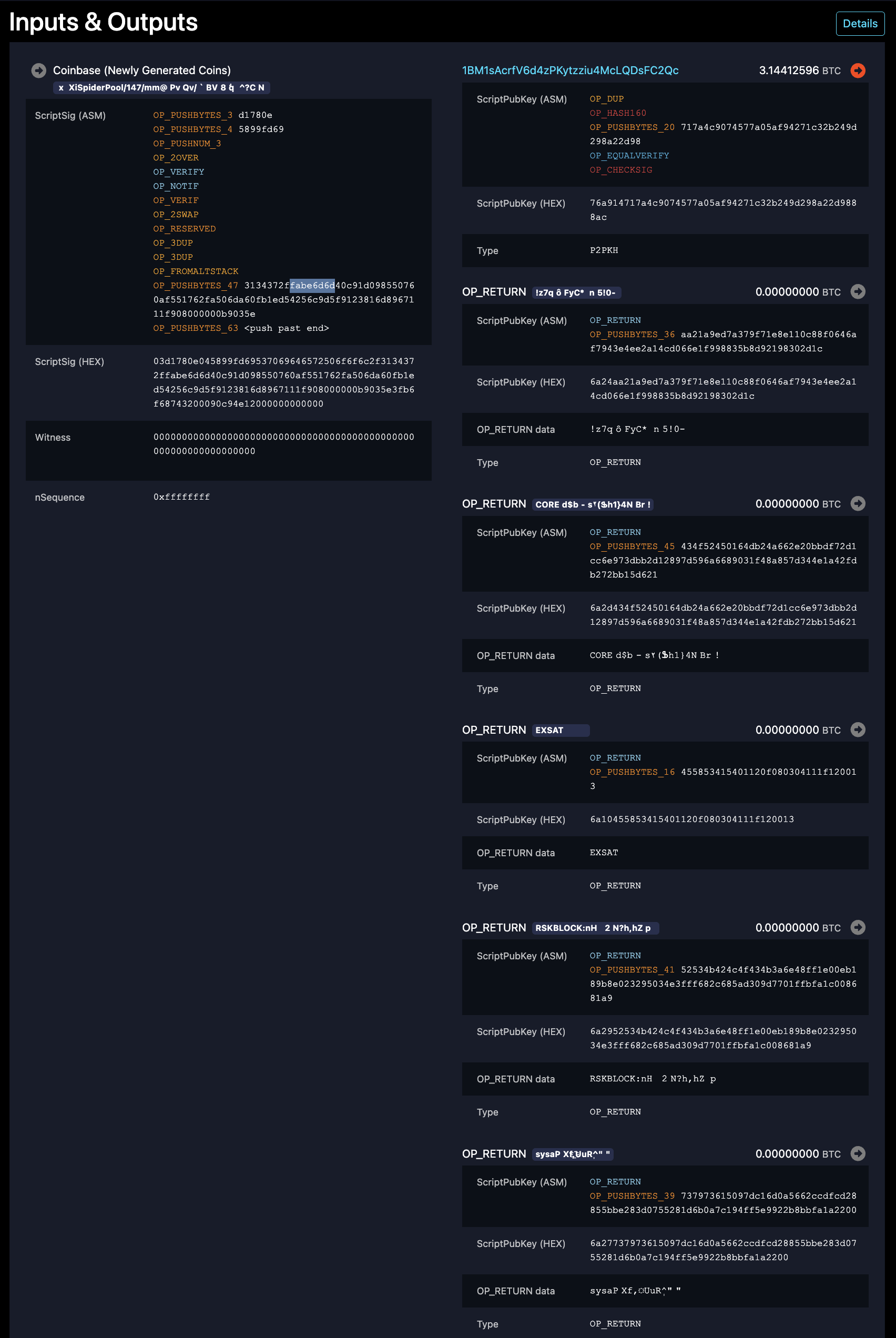
The coinbase of block 948,433, mined by SpiderPool, is one such case (Figure 11):
OP_RETURN aa21a9ed7a379f...        SegWit witness commitment (BIP 141, mandatory)
OP_RETURN CORE 01 64db24a6...      CoreDAO hash-delegation metadata
OP_RETURN EXSAT 01 120f0803...     exSat synchronizer metadata
OP_RETURN RSKBLOCK: 6e48ff1e...    RSK merge-mining commitment
OP_RETURN sys 615097dc...          Syscoin merge-mining commitment
: multiple zero-value `OP_RETURN` outputs in the `scriptPubKey`s carrying the SegWit witness commitment, merge-mining commitments, and other project/protocol metadata, while the input `scriptSig` carries an AuxPoW marker, showing that this block is also a parent for AuxPoW chains (dissected below).](/assets/blog/2026/merge-mining/mempool-space-block-948433.png)
OP_RETURN outputs in the scriptPubKeys carrying the SegWit witness commitment, merge-mining commitments, and other project/protocol metadata, while the input scriptSig carries an AuxPoW marker, showing that this block is also a parent for AuxPoW chains (dissected below).Compared with AuxPoW, tag-based approaches avoid the shared tree, chain-ID coordination, the broken merkle_nonce collision-avoidance scheme, and the marker placement rule.
A miner participating in multiple such systems simply emits one coinbase OP_RETURN output for each system.
What these approaches give up is the shared verification model. Each tag-based chain defines its own rule for what counts as a valid Bitcoin parent and how the parent header or Bitcoin block metadata is carried in its own format. There is also no single specification document equivalent to the Merged mining specification; each chain defines its own.
The two mechanisms coexist in the same Bitcoin coinbase because they live in different fields: AuxPoW commits via the input scriptSig, OP_RETURN tag-based approaches commit via output scriptPubKeys.
Bitcoin block 948,433 as examined above illustrates this (Figure 11): alongside five OP_RETURN outputs (the SegWit witness commitment plus four project/protocol tags, including RSK/Syscoin merge-mining commitments and Core/exSat coordination metadata), the coinbase scriptSig carries an AuxPoW marker that, with merkle_size = 8, commits to up to eight auxiliary chains:
"03d1780e"                                                         // BIP 34 push: parent height 948,433
"045899fd69"                                                       // 4-byte push: pool extranonce (LE u32 = 0x69fd9958)
"537069646572506f6f6c2f3134372f"                                   // 15-byte ASCII tag: "SpiderPool/147/"
"fabe6d6d"                                                         // AuxPoW magic
"40c91d098550760af551762fa506da60fb1ed54256c9d5f9123816d8967111f9" // aux_merkle_root
"08000000"                                                         // merkle_size = 8 (LE u32)
"b9035e3f"                                                         // merkle_nonce (LE u32 = 0x3f5e03b9)
"b6f68743200090c94e12000000000000"                                 // trailing scriptSig bytes (pool extras)
That is, AuxPoW and tag-based commitments can reuse the same Bitcoin proof-of-work in the same parent block.
On the Namecoin side of this commitment, Namecoin block 823,793 carries Bitcoin 948,433's 80-byte header inside its AuxPoW record at slot 4 of the marker's 8-slot tree, exactly the side-channel introduced earlier in the post.
The full mempool.space view of this coinbase, with the AuxPoW magic highlighted in the scriptSig, is shown in the full coinbase breakdown below for reference.
Full coinbase breakdown of Bitcoin block 948,433
Conclusion
AuxPoW gives an auxiliary chain a way to reuse Bitcoin's proof-of-work without any participation from Bitcoin itself. This satisfies the idea Satoshi proposed in 2010: the parent network needs no coordination with any auxiliary chains, yet many chains can share the parent's hashing effort through a single coinbase commitment to a shared merkle slot tree of auxiliary block hashes.
A single SHA-256d evaluation of the parent header serves both sides.
The hash is tested against parent_target on Bitcoin's side and against aux_target on the auxiliary chain's side (almost always the easier threshold), with three possible outcomes: rejected, aux-only valid, or both parent and aux valid.
The AuxPoW specification makes this verifiable on the auxiliary side using three pieces.
A 44-byte AuxPoW marker in the parent coinbase scriptSig binds the parent block to that shared merkle slot tree of auxiliary block hashes.
An AuxPoW record on the auxiliary chain carries the parent coinbase, the parent header, and the merkle paths needed to verify that commitment.
A five-step verification rule then validates the PoW link regardless of whether Bitcoin's canonical chain ever accepts the parent block.
Together the three pieces let the auxiliary chain treat any candidate hash that clears aux_target as proof-of-work for its block, whether or not Bitcoin accepts the parent.
Every AuxPoW record also retains its full parent header, including headers Bitcoin's canonical chain discarded, making AuxPoW chains a side-channel into Bitcoin's PoW history.
OP_RETURN tag-based merge mining sits alongside AuxPoW as a lighter, per-chain alternative: a coinbase OP_RETURN output per chain rather than a shared scriptSig marker, with each chain free to define its own tag, payload format, and commitment semantics (e.g., PoW binding like AuxPoW, or another purpose such as delegation accounting or reorg-safe state notarisation).
The two embedding locations coexist in the same coinbase without interfering (Figure 11): AuxPoW commits via the input scriptSig, OP_RETURN tag-based approaches via the output scriptPubKeys.
A companion post catalogues every chain that has actually deployed AuxPoW with Bitcoin as its parent, and examines which Bitcoin mining pools embed merge-mining commitments in their coinbases.
A separate follow-up post will use the side-channel AuxPoW creates (auxiliary chains preserving parent headers Bitcoin discarded as stale) to put numbers on a long-standing claim about block propagation: that smaller mining pools produce more stale blocks, relative to their hashrate, than larger ones.
References
Specifications and primary sources
- Merged mining specification (Bitcoin Wiki)
- Community catalogue of merge-mined chain IDs (BitcoinTalk thread 769073)
- BitDNS and Generalizing Bitcoin (BitcoinTalk, November 2010)
- Satoshi: BitDNS as a separate chain sharing proof-of-work (BitcoinTalk, 9 December 2010)
- Namecoin merge-mining hard fork announcement, block 19,200 (Namecoin Forum, 2021 Wayback snapshot; the live forum has been down since May 2025)
- Nonce for merged mining chain merkle tree index (BitcoinTalk)
- Namecoin project site
- BIP 34: Block v2, Height in Coinbase
- BIP 141: Segregated Witness (Consensus layer)
- BIP 300: Hashrate Escrows (Drivechains)
- BIP 301: Blind Merged Mining
- RSKIP-92: Merkle proof serialization for merge-mined RSK blocks (Rootstock)
- Syscoin 5.0.0 release notes: AuxPoW tags
Papers and long-form explainers
- Stifter, Schindler, Judmayer, Zamyatin, Kern & Weippl. Echoes of the Past: Recovering Blockchain Metrics From Merged Mining (FC 2019)
- Zamyatin, A. Merged Mining: Analysis of Effects and Implications (TU Wien diploma thesis, 2017)
- Judmayer, Zamyatin, Stifter, Voyiatzis & Weippl. Merged Mining: Curse or Cure? (CBT 2017)
- Tari Labs University: Merged Mining Introduction
- Mempool Research: Merge-mining report
- BitMEX Research: The Growth of Bitcoin Merge Mining (2020)
- Sergio Demian Lerner: Merged mining (Part I) (Bitslog, 2022)
- learnmeabitcoin: Nonce (interactive extranonce explainer)
- Linear congruential generator (Wikipedia)
Reference implementations and worked-example data
- Namecoin Core:
src/auxpow.cpp(the canonical C++ AuxPoW verification) - Elastos.ELA:
auxpow/auxpow.go(Go port of the same verification logic) - Bitcoin Core:
src/consensus/tx_check.cpp(coinbasescriptSiglength limit) - Namecoin block 823,506 (chainz.cryptoid.info)
- Bitcoin block 948,433 (mempool.space)
- Namecoin block 823,793 (chainz.cryptoid.info), the aux-chain block parented by Bitcoin block 948,433
Cite this post
deadmanoz (2026). Merge mining and AuxPoW: how it works. deadmanoz.xyz. https://deadmanoz.xyz/posts/2026/merge-mining (last updated 2026-09-04).